
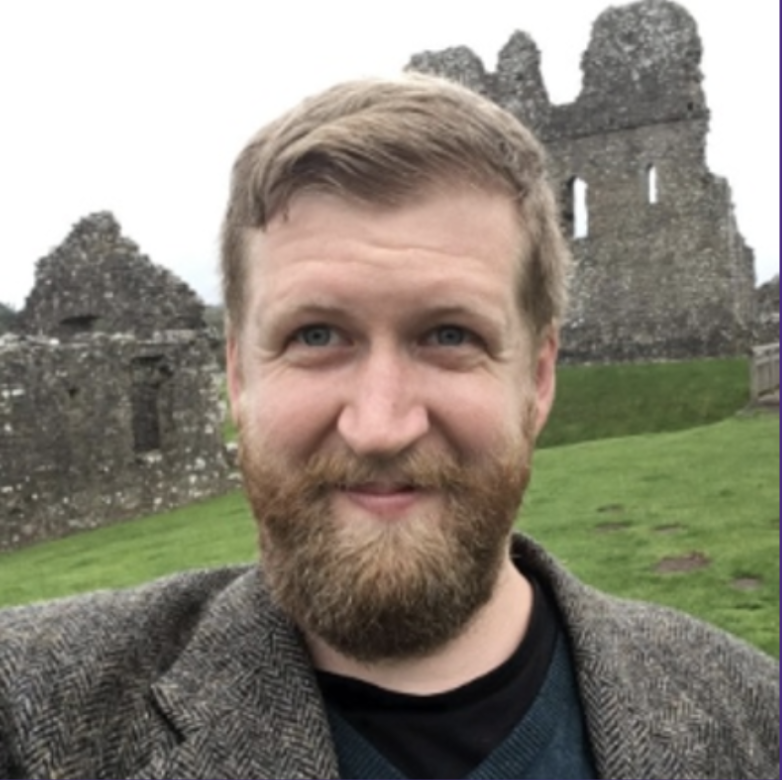
Dr. Chris Letheby is a superstar philosopher at UWA. He is not just a great person to interact with but he clearly has one very intriguing research topic: the philosophy of psychedelics. Below is the, mildly edited, transcript from an interview with Chris. The interview was conducted by our very own Sagacity Magazine editor, Lucia C. Neco.
1a. Can you tell us what brought you to study philosophy, and in particular, to your research on psychedelics?
I had a long-standing interest in mysticism and spirituality and altered states of consciousness since my late teens. And this is part of why I studied philosophy in the first place, because I was interested in these big questions. And then just as I was going from my master's into my PhD, I learned a bit about psychedelic drugs. Up until that point, I had been pretty ignorant about psychedelics – I thought they were hallucinogens, drugs whose primary effect is to make you see things that aren't there. And then I learned to my great surprise that that's not really what they are, that there's a whole lot more that they do.
1b. How did you learn that [that psychedelics are not hallucinogens]?
In the first instance, I got knowledge by description. Then I got knowledge by acquaintance. I learned about psychedelics by reading about them and being told about them by people I knew. And then I decided I had to find out for myself, so I did.
1c: Do you think that even people with experience using psychedelics would say that they are only hallucinogenic?
… there definitely are lots of people who have psychedelic experiences and don't find them particularly meaningful or significant. And there are lots of psychedelic experiences that are primarily centred around perceptual effects, that mainly are about seeing distortions and pseudo-hallucinations and this kind of thing. These effects can be very interesting in their own right, but the effects that are philosophically most interesting tend to emerge under certain sorts of conditions, at higher doses and in more introspective settings. So it's when people are taking psychedelics in traditional religious rituals or ceremonial settings, or in controlled psychiatric settings, and they're not taking a tab of acid at a rave or a party.
Still, even in these circumstances, people can have meaningful experiences and spiritual experiences. But the experience itself is so variable that certainly a lot of people have had encounters with psychedelics and come away without any awareness that there's more to it than just interesting perceptual effects and hedonistic recreation. But if you have the right dose and the right circumstance, there can be a lot more to it than that.
So if you have the same dose at a rave or a party versus in a hut in the Amazon chanting Icaros or whatever, you're going to have a very different experience.
2a: Your recent book Philosophy of Psychedelics argues for a naturalistic account of psychedelic experience. Firstly, can you tell us what is meant by ‘naturalistic’ here? And second, how does your view differ from the way psychedelic events are typically understood?
People have psychedelic experiences, and very often they're transformed by them in psychologically beneficial ways. Setting aside some methodological problems, most people can agree on that as an empirical claim. But then people also say, ‘this was a spiritual experience’ or ‘this was an epistemically beneficial experience’. And generally speaking, the people who say those kinds of things tend to be non-naturalists. By calling it a spiritual experience, they usually mean something like they were in contact with the ultimate ground of being, a cosmic consciousness, or a spirit world. And when they talk about it as being epistemically beneficial, they often have something like that in mind too. So what I've been trying to argue is that even a naturalist can correctly say that transformative psychedelic experiences are spiritual and epistemically beneficial. Attributing those properties to psychedelic experience doesn't depend on embracing any non-naturalistic metaphysics.
2b: And how can it be spiritual if it's natural?
This is where it gets nice and philosophical, because we have to ask: what does spiritual mean – and the answer is, like most things, it doesn't just mean one thing. The word gets used in many different senses, and there is going to be at least one sense in which it entails metaphysical belief in spirits or the spiritual. So in that sense, of course, spirituality can't be reconciled with naturalism. But there's another sense in which the term gets used that is most evident in the phenomenon of people calling themselves “spiritual but not religious” or SBNR. So there clearly is this other sense in which the term spiritual is being used [without] necessarily having that non-naturalist or supernatural view to it.
If you look at what people mean when they call themselves spiritual, while saying they're not religious, part of it is about not belonging to a formal institution. But a lot of it also has to do with practice over theory, and experience over dogma. So being spiritual is about having some kind of interest in questions of ultimate meaning, that one approaches in a practical and experiential fashion – undertaking practices that are meant to induce transformative experiences.
Then there is this sort of cottage industry, in philosophy and other disciplines, of trying to naturalize spirituality, saying: “look, here is at least one thing that is referred to by one sense of the term ‘spirituality’ that doesn't depend on non-naturalistic beliefs”.
The philosopher Jerome Stone surveys 12 different accounts of naturalistic spirituality and abstracts three common threads: spirituality is about: 1) connection, 2) aspiration, and 3) asking the big questions. So we're spiritual when we undergo or cultivate a sense of connection or connectedness with things or beings or realities other than ourselves; when we aspire to realise our values; and when we contemplate the big questions. Stone says that the common thread in all of these is breaking through the narrow walls of the ego and transcending the ordinary sense of self.
I think that the evidence from psychedelic science supports Stone’s idea. These three characteristics come up very commonly in psychedelic experience. Interestingly, they tend to appear when people satisfy the psychometric criteria for what’s called a ‘mystical-type experience.’
In the psychology of religion, this construct of the mystical-type experience comes from people like William James and Walter Stace, and it has now been turned into a psychometric construct.
You're deemed to have had a “complete” mystical-type experience if you score 60% or above on all the subscales of the Mystical Experience Questionnaire. And this becomes very important in psychedelic research because it seems like having such an experience is the strongest predictor of not just therapeutic benefits, but also transformative benefits if the subject doesn’t have a psychiatric diagnosis.
So if we want to understand how psychedelics are able to transform people psychologically, it's really important to understand this construct of a mystical-type experience: what exactly this class of experiences is and what they're all about. A central strand in my book is to say, well, they're not actually all about non-naturalistic metaphysical ideations.
If you look at everyone who is satisfying the psychometric criteria, some people are describing merging with a cosmic consciousness or a divine ground of being. Some are not. But the common thread is all this other stuff, breaking through the narrow walls of the ego, connection, aspiration, asking the big questions. These are consistent hallmarks of the mystical-type experience, whether you've got non-naturalistic ideas in the mix or not.
To really understand what is going on in these experiences, you have to look at qualitative research, at the interviews that are being conducted with these patients, because the psychometric statistics have their limits.
You get a really nice illustration of this in Michael Pollan's book, How to Change Your Mind, about psychedelics. In it, he interviews researchers and clinicians and subjects and, like a good journalist, he has to have some experiences himself. So he has some trips and he writes all about them.
It's very revealing because he doesn't use the philosophical jargon, but Pollan himself is a thoroughgoing naturalist. After an experience he has on psilocybin, he basically says flat out: ‘I was a naturalist before this experience and I remained a naturalist after it. It didn't tempt me to believe in anything non-naturalistic or supernaturalistic’. Yet when he fills out this Mystical Experience Questionnaire, he satisfies the criteria and scores 60% or above on all of these subscales. So that's sort of a proof of concept that you can have an experience that's captured by that psychometric net, even though it doesn't include non-naturalistic ideas.
So then, when you look at all these qualitative studies, you find that some people are talking about cosmic consciousness, or a divine ground of being, but they tend to make up a minority. What almost everyone is talking about is all this other stuff, feelings of connectedness and acceptance and mindfulness and embodiment and, you know, reconnecting with one's values and what really matters, what's most important. And those things are natural things. That's all stuff a naturalist can get on board with.
3a: Would you say that part of what happens when you have a transformative psychedelic experience is that you gain a kind of knowledge?
Yes, I've got five kinds —a whole taxonomy. The one that is philosophically most interesting but hardest to establish is propositional knowledge.
3b: Right – so that would be if you could take a drug and, as a consequence, get some new justified true belief that you didn't have before?
Yeah. And I actually think this does happen in the domain of psychodynamic self-knowledge. I'm not necessarily getting on board with any full-blown psychoanalytic theory here, just the idea that we can have beliefs, motivations, desires, or intentions that are in some sense unconscious or unknown to us in the ordinary course of things. I think that's clearly true. So you get true justified beliefs about yourself, about your own mental states. And certainly it seems to people as if they do.
Timothy Leary had psilocybin and said he learned more in those six hours than in 15 years of being a psychologist. He was an eminent personality psychologist before he ever had psychedelics. And this is not uncommon. Benny Shanon, who was a cognitive psychologist, took ayahuasca for the first time and said “I learned more about the human mind in those six to eight hours than I had in 20 years being an academic psychologist”.
So these sorts of things are, in general terms, about learning general facts about the human mind. But very often people will say, “I learned why I keep sabotaging myself in my relationships. It's because I have this particular fear," or "I learned what childhood trauma is really underlying my addiction”. People describe these extremely powerful, extremely convincing, apparent psychodynamic insights into their own previously unconscious or unknown mental states, beliefs, desires, motivations, etc.
As Thomas Metzinger points out, a simple explanation – especially given that very often after the experience the symptoms improve when people have a clinical condition – is that the insights are genuine. People really are getting insight into their own previously unconscious mental states that are at the root of pathological patterns of thought, feeling, and behaviour.
The problem is that other explanation is: “the insight is bogus”. It’s what David Jopling calls a “placebo insight” – something that seems like an insight, but is not veridical, but still makes you get better nonetheless. And this is one of the biggest unsolved problems in psychedelic epistemology. Because it just seems obvious that sometimes these insights are going to be veridical. They can't all be false. And it seems obvious that sometimes they're going to be false.
3c: So is one question, ‘how do you tell whether you have an insight or a placebo insight?’? And is there any good argument for thinking that most of them are going to tend one way or the other?
There are a couple of arguments you can make. You might say psychedelics demonstrably cause misrepresentation of the external world – you see walls as moving when they're actually stationary and things like this – so we should be suspicious about the internal domain given their track record about the external world.
But the way I go is to say, well, look, we actually know that the psychedelic experience has interesting commonalities with mindfulness practice. And there's some evidence that mindfulness practice can improve the accuracy of introspection. So you can tell a story according to which psychedelics attenuate certain self-representational processes in the brain that ordinarily bias us, that lead us to not want to realise certain facts about ourselves. And that by downregulating those sorts of processes, psychedelics, when things go well, can actually promote a more open, less biased, and potentially more accurate mode of introspection.
So that's an argument that I make on theoretical grounds. But I'm the first to admit it's not conclusive.
…Stay tuned for part two of this conversation with Dr. Chris Letheby!