

I’m getting married next year, and like many engaged couples, my fiancée and I face the tricky question: what should we do with our surnames? Most writing about “surnaming” focuses on our actual, usually non-ideal, world—i.e., what is common, what is practical, or what constitutes a good response to patriarchal gender norms. But in this article, I want to consider what surnaming should be in an ideal world. If we could make one surnaming practice universal with the snap of a finger, what should we choose? Hopefully, answering this question will provide a generalisable strategy for navigating what to do with our surnames once we get married here in the actual world.
Here are some salient surnaming strategies, illustrated using the fictional couple Sam Tran and Riley Walker (see Figure 1).
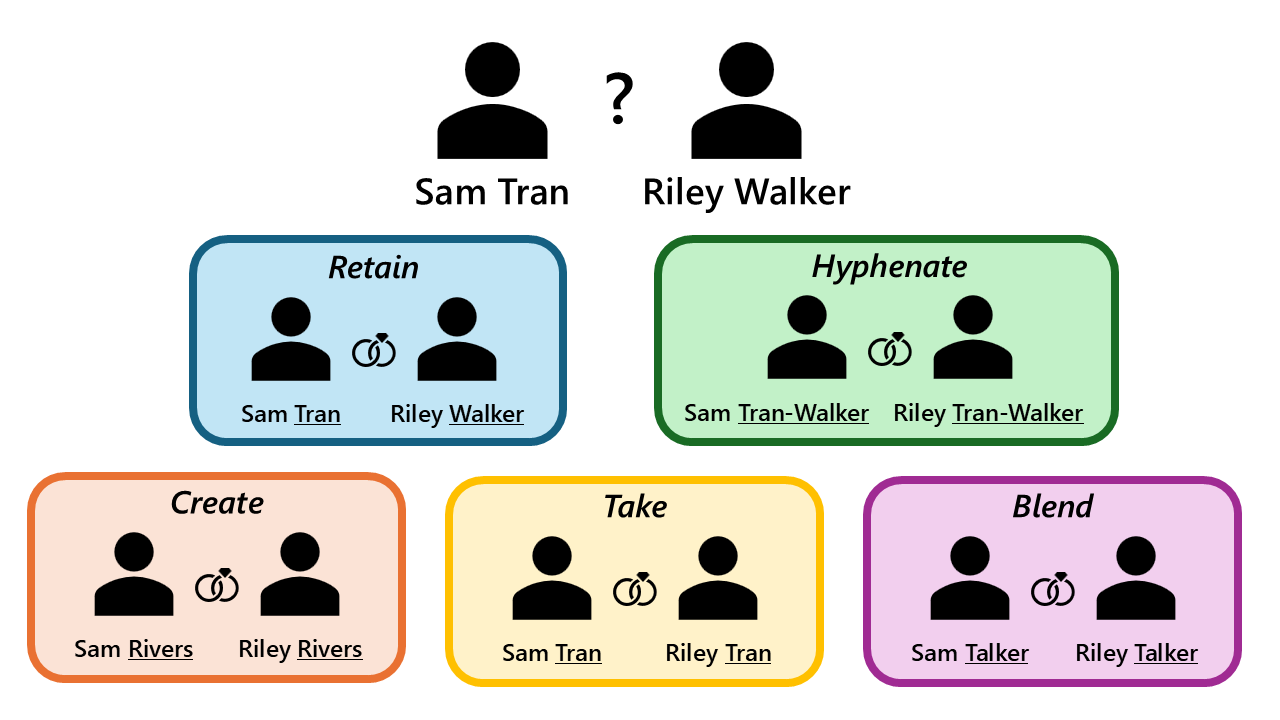
Figure 1: Some strategies for surnaming (choosing surnames).
1. Retain: Each keeps their own surname (Sam Tran, Riley Walker)
2. Create: Both share an entirely new surname (Sam Rivers, Riley Rivers)
3. Hyphenate: Both hyphenate surnames (Sam Tran-Walker, Riley Tran-Walker)
4. Take: Both take one surname (Sam Tran, Riley Tran)
a. Take (consensus): by consensus
b. Take (coin flip): by coin flip
c. Take (male): if exactly one partner is male, that name is taken
d. Take (female): if exactly one partner is female, that name is taken
5. Blend: Both share a new, blended surname (Sam Talker, Riley Talker)
In the actual world, couples’ surnaming strategies are often guided by culture or constrained laws. We don’t have the best data, but the patriarchal tradition of Take (male) seems to be chosen by a majority of women in heterosexual couples in many countries, including Australia, the USA, and Japan. But not all couples are heterosexual, and each of the five strategies that I’ve mentioned has been recently used by some Australians stepping outside that patriarchal tradition. In other places, the law mandates one strategy: Take (either) is mandatory in Japan, and Retain is mandatory in Quebec and Greece. This article, however, is concerned with an ideal world. What should we do with our surnames if all gendered, cultural, and legal constraints were never there in the first place? And to make this question more tractible, what would be the best universal surnaming strategy?
In this article, I’ll seek a strategy that can pass three basic tests: (A) it can name couples and children, (B) it can reflect family connection, and (C) it is psychologically feasible. I’ll explain these tests as I review which strategies can pass them.
Test (A) exists because any universal strategy needs to provide surnames for children, too—i.e., even if many couples do not have children, a universal strategy will provide a naming strategy for the children of those who do. Because babies don’t already have last names, Retain does not pass this test. Each parent having retained their last name (Sam Tran & Riley Walker) does not provide a strategy for naming their child. They must pick a different strategy, e.g., Take or Hyphenate, for the child’s surname (outside of the rare cases where the parents already had the same last name when they met, hopefully by coincidence). So for now, let’s set Retain aside.
Test (B) is the central, substantive assumption of this article: a surname should be able to represent one’s connection to one’s family. I don’t have room to argue for this hopefully plausible assumption; I am instead just focusing on which strategy to pick if it is true. Here, I also assume that two surnames can be connected to each other by degrees. Two people’s names are fully connected if they completely match (Tran & Tran) and partially connected if they partially match (Tran, Tran-Walker). The best strategy would maintain your connection to your family members, by maintaining the connection between your surnames. Ideally, you would have the same surname as your immediate family members; then priority is given to grandparents, grandchildren, first cousins and “niblings” (nieces and nephews of any gender); then priority is given to great-grandparents and so on.
To judge test (B), visualise the following. Your family tree extends out from you across a dark void: nearest is your immediate family, then family members you’ve met, then those you’ve only heard of, then countless unknown relatives in the distance. Who should be able to be illuminated by surname-connection, and how bright (close) should that connection be? According to this test, the light of surname connection should be able to radiate out through your closest family members first, then illuminate other family members as much as possible, prioritising based on closeness.
This shows that Create is too limiting. It brightly illuminates some immediate family members, but no others. It would be the case that, when you’re a child, it’s just your siblings and parents who share your last name. Later, if you, a sibling, or a parent (re- )marries (and Creates anew), then you would be suddenly, completely disconnected. The other remaining options—Hyphenate, Take, and Blend—can each illuminate immediate family members and at least some others, so they score better on test (B) and remain in the running.
Test (C) is that a surname should be psychologically feasible: sufficiently easy to remember, pronounce, and write down. This standard is meant to be very broad and contextual, but it rules out Hyphenate as our universal strategy. Suppose that everyone Hyphenated from now on. Sam Tran-Walker and Riley Tran-Walker name their child Charlie Tran-Walker. When Charlie Tran-Walker marries Alex Williams-Lee, they hyphenate, too, naming their child Kim Tran-Walker-Williams-Lee. Kim hyphenates with her partner, creating an 8-part hyphenation, begetting 16, then 32, 64, and so on. This is the problem of Exponential Hyphenation Growth. Perhaps technology can allow the 256-part hyphenatees to easily write their names on government forms, but it would at least be infeasible for one to pronounce, and for those one meets to remember. As with lossy compression in computing, we need to pick which information to prioritise in a limited format. This leaves us with Take and Blend as universal strategies, which we can separate by how well they score on test (B).
Picture the family tree from before, illuminated by universal Take (male). This common strategy will require the false assumption that all couples are male/female. This draws a bright line through your parents and siblings, your father’s parents and siblings, his father’s parents and siblings, and each couple in turn, but leaves dark each maternal line and each woman who marries: they get an unrelated name. This leaves you perfectly connected to a man dozens of generations back, but not to a sister who was married, to your mother’s parents, or to maternal first cousins. This is sexist, but any version of Take (such as strategy d. Take (female)) would be arbitrary in the same way just described: leaving off some nearby family members in favour of a single, sharp, historical family line, even if it zig-zags by coin flips or consensus decisions. See Figure 2 for an example in which a given person’s surname has the kind of arbitrary connections that result from universal Take.
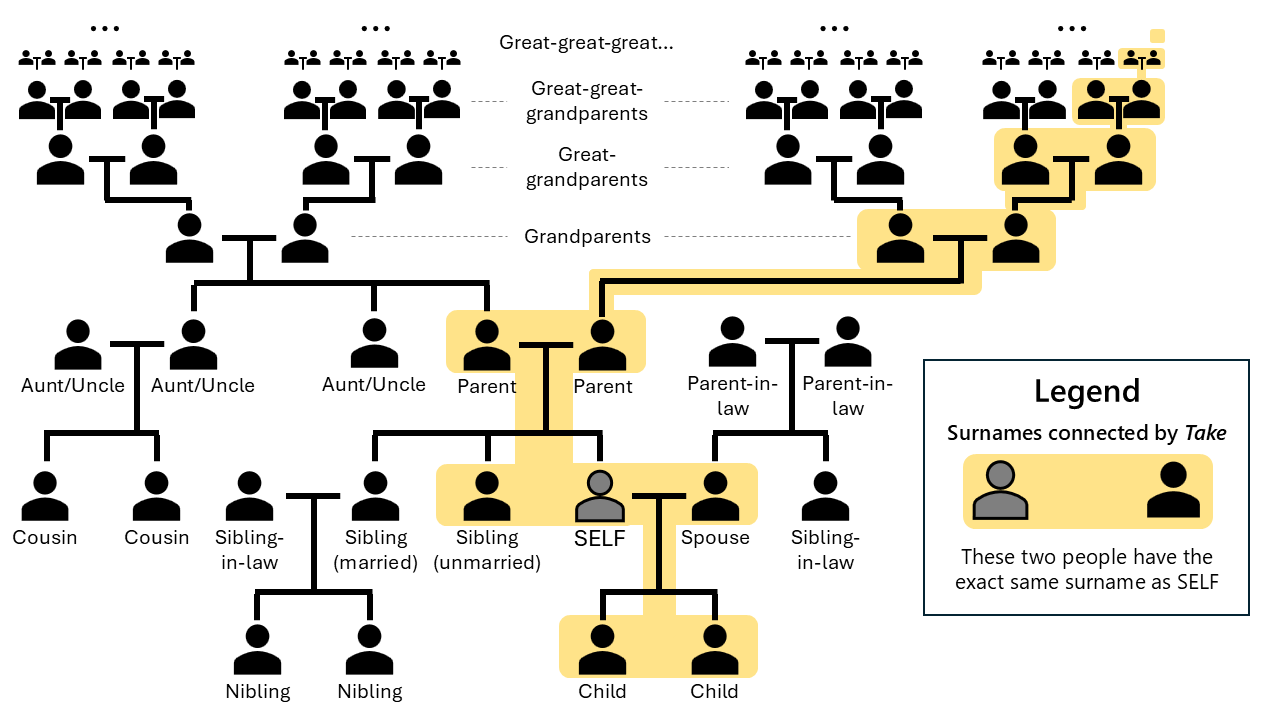
Figure 2: An example of which family members your surname might be connected to if Take were universal.
This is ultimately why Blend is best: connection to other family members is even, non-arbitrary, and adequately compressed. As with Hyphenate, you share a connection to your immediate family members. Sam Talker and Riley Talker would have the same name as their children, Charlie and Ari Talker, at least until their children start their own families. They would be partly connected to those with Riley’s original surname Walker, one blending-step away. Riley’s parent’s previous surnames (Walton and Parker) are two blending-steps away.
Blending need not be based on spelling or sound: a semantic blend based on the meaning of words could also constitute a family link that allows a person to trace their connections through that link to other family members. At last, using Blend, the plane of your family members is illuminated proportionately: connecting you to each of your family members in proportion to their closeness to you, with a name that is easy enough to pronounce and remember. See Figure 3 for an example of this more even kind of connection.
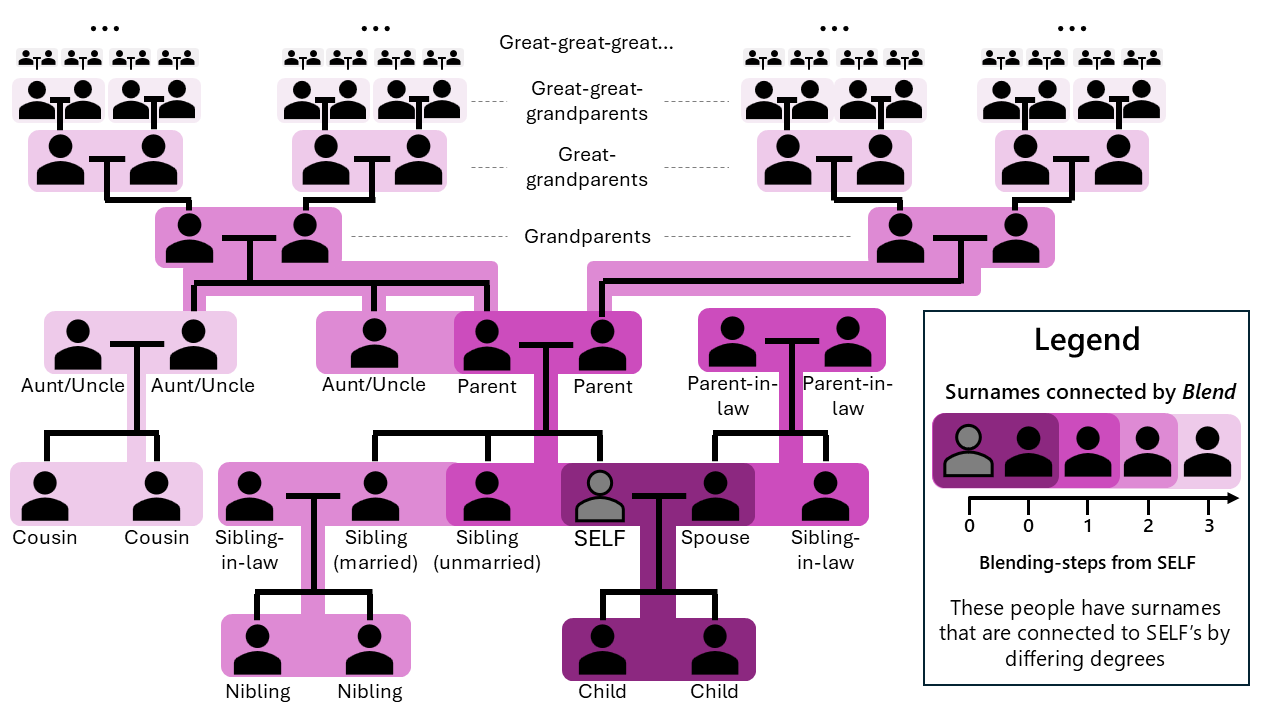
Figure 3: An example of which family members your surname might be connected to if Blend were universal, noting that connection can differ by degrees.
So, in the ideal version of the world in which there is one, universal naming strategy, we would all Blend. What does that mean for us here at home? Well, us couples in the actual world have plenty of other reasons to pick a strategy, some of which might be decisive. Perhaps we Retain because we aren’t planning children—or wait to change names until we do. Perhaps we both just love one name and Take (consensus), or want a real spectacle at the wedding, and pick Take (coin flip). We might Take or Create if we want not to be connected to some part of the family. We might even pick different strategies legally, professionally, and informally, if one faces competing considerations in those domains. Hopefully, though, I have invited you to take Blending seriously, or at least consider it as the best ideal universal surnaming strategy.